
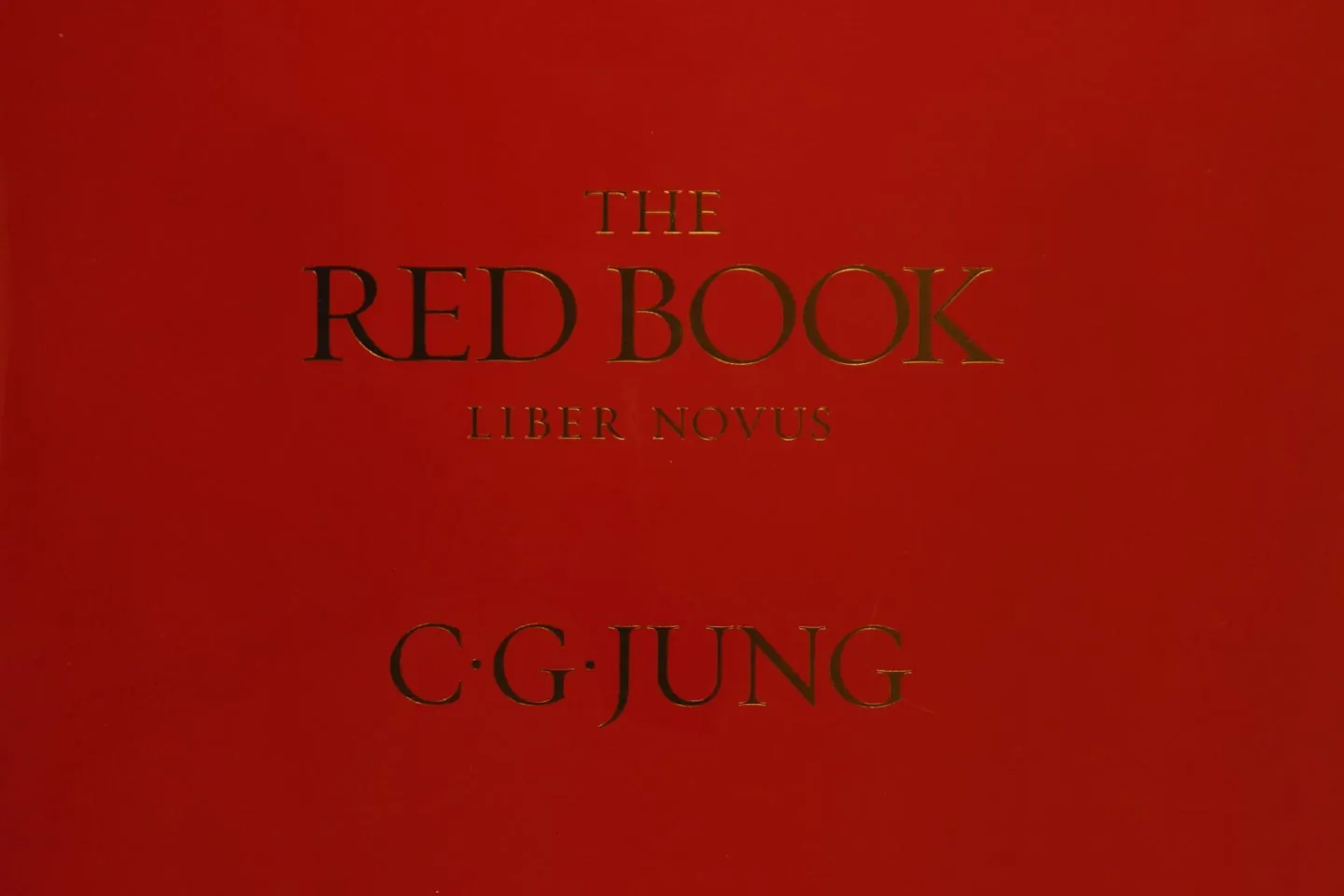
What is the Red Book?
The Red Book is a folio manuscript that Carl Jung wrote and painted by hand over roughly sixteen years. Its formal title is Liber Novus, the New Book. It contains the record of what Jung later called his confrontation with the unconscious: a sustained period in which he deliberately induced and then engaged with fantasies, visions and inner figures, wrote down what happened, and argued with what he found.
It is not a treatise, and it is not a diary in the ordinary sense. It is closer to a work of visionary literature, written in a deliberately archaic voice, illuminated like a medieval devotional book, and produced by a working psychiatrist at the height of his professional life who told almost nobody what he was doing.
Jung’s own assessment, given late in his life, was that everything he did afterwards came out of those years. The theoretical work that made his name, the archetypes, the collective unconscious, individuation, active imagination, was in his account the scientific elaboration of material that first arrived here.
Why he made it
In 1912 and 1913 Jung’s professional life came apart. His book Psychology of the Unconscious had ended his friendship and collaboration with Freud, and with it his standing in the psychoanalytic movement. He resigned his lectureship. He was, by his own description, disoriented and without a footing.
What he did next is the unusual part. Rather than waiting for the disturbance to pass, he went towards it deliberately. From late 1913 he began letting fantasies come, recording them as they happened, and then entering into dialogue with the figures that appeared. He treated his own unconscious as something with its own intelligence, capable of being addressed and capable of answering back.
This is the origin of what he would later formalise as active imagination, and it is why the Red Book matters clinically rather than only historically. The method Jungian analysts still use was first worked out by Jung on himself, at considerable personal risk, in these pages.
The Black Books and the calligraphic volume
There are really two documents.
The first is a set of small notebooks, later known as the Black Books, in which Jung recorded the fantasies as they occurred from late 1913 onwards. These are the raw material: immediate, unedited, often disturbing.
The second is the Red Book itself. From around 1914 Jung began transcribing that material into a large red leather volume, adding commentary and reflection as he went, in a careful calligraphic hand. He worked at it in the evenings, after days of lecturing and seeing patients. He continued for roughly sixteen years and never finished. The manuscript stops, unresolved, around 1930.
That unfinished quality is worth sitting with. The book does not arrive at a conclusion because the process it records did not have one.
The illustrations and the calligraphy
The visual dimension is not decoration. Jung painted mandalas, figures, cosmologies and abstractions directly into the manuscript, and the images frequently carry meaning the text does not state.
Scholars have often compared the result to a Book of Hours, the illuminated devotional manuscripts of the medieval period, in which image and text work together and the labour of making is itself part of the devotion. The comparison is apt in more than style. Jung was not illustrating an argument. He was using painting as a second language for material that resisted being said.
For anyone approaching the book for the first time, this is the practical advice most worth having: do not treat the images as accompaniment to the words. Spend time with them separately. They were made with the same seriousness.
Philemon and the inner figures
The dialogues are conducted with figures who arrive with their own character and will. The most significant is Philemon, an old man with kingfisher wings who becomes something like a teacher.
Jung’s account of Philemon is one of the clearest statements he ever made about the autonomy of the psyche. He described realising that Philemon said things Jung himself had not thought and did not agree with, and that this forced him to recognise there were things in the psyche that he did not produce and could not control.
That recognition is the foundation of the whole analytical psychology project. It is also, incidentally, why the foundation that sponsored the book’s publication is called the Philemon Foundation.
Why it stayed unpublished until 2009
Jung did not publish it in his lifetime, and after his death in 1961 his family kept it private for decades. The reasons were reasonable ones. The material is intensely personal. It could be, and has been, misread as evidence of psychosis. Releasing it risked recasting a body of scientific work as the product of a breakdown.
The manuscript spent years in a bank vault in Zurich. Persuading the family took considerable time, and preparing the edition took longer still.
The Red Book: Liber Novus was finally published in October 2009 by the Philemon Foundation and W. W. Norton, edited and introduced by Sonu Shamdasani, and translated by Mark Kyburz, John Peck and Sonu Shamdasani. The first edition is a full-size facsimile, reproducing the manuscript page by page alongside the translation and Shamdasani’s extensive scholarly apparatus.
The reception settled the question the family had worried about. The book is now generally read not as a record of illness but as the source from which the rest of the work grew.
How to read it
The editions. The 2009 facsimile is a large and expensive object, and it is the only way to see the manuscript as Jung made it. A subsequent Reader’s Edition presents the text and Shamdasani’s introduction and notes without the full-size reproductions, at a fraction of the cost. If you want the argument, the Reader’s Edition is enough. If you want the book, you need the facsimile.
On finding it as a free PDF. The text and images are in copyright and the scholarly apparatus represents years of work by the editor and translators. Scanned copies circulating online are unauthorised and usually poor reproductions of a work whose visual quality is the point. Many university and city libraries hold the facsimile in their reference collections, which is the better route if the price is prohibitive.
On reading it alone. The book is difficult, and not only intellectually. It is written to unsettle, and it works. People who read it in isolation, particularly at a turbulent point in their own lives, sometimes find it destabilising rather than illuminating. Reading it in company, and slowly, tends to go better.
What it means for analysis today
The Red Book is the reason Jungian analysis takes imagination seriously as a way of knowing rather than as a diversion from it.
Everything that follows from it is practical: the use of dreams as material to be worked with rather than decoded, the practice of active imagination, the willingness to treat an inner figure as having something to say, the understanding that a period of disorientation may be the beginning of something rather than simply a failure. These are not literary ideas. They are what happens in the consulting room.
The book also offers a corrective that is easy to lose. Jung did not arrive at his psychology by observing patients from a safe distance. He arrived at it by going into his own material first, and writing down what he found there, at a time when he had no way of knowing whether he would come back out with anything useful.
The reading group
The Jungian Confrerie runs a reading group for people who want to work through Jung’s texts, the Red Book among them, in company rather than alone. It meets in a confidential setting and is led by Dr Philippe Jacquet, a Jungian analyst trained with the Association of Jungian Analysts.
It is a reading group rather than a course. Nothing is assessed, nothing is awarded, and it leads to no qualification. What it offers is the difference between reading this material by yourself at two in the morning and reading it with other people who are taking it equally seriously.
To ask about joining, or about analysis itself, get in touch.